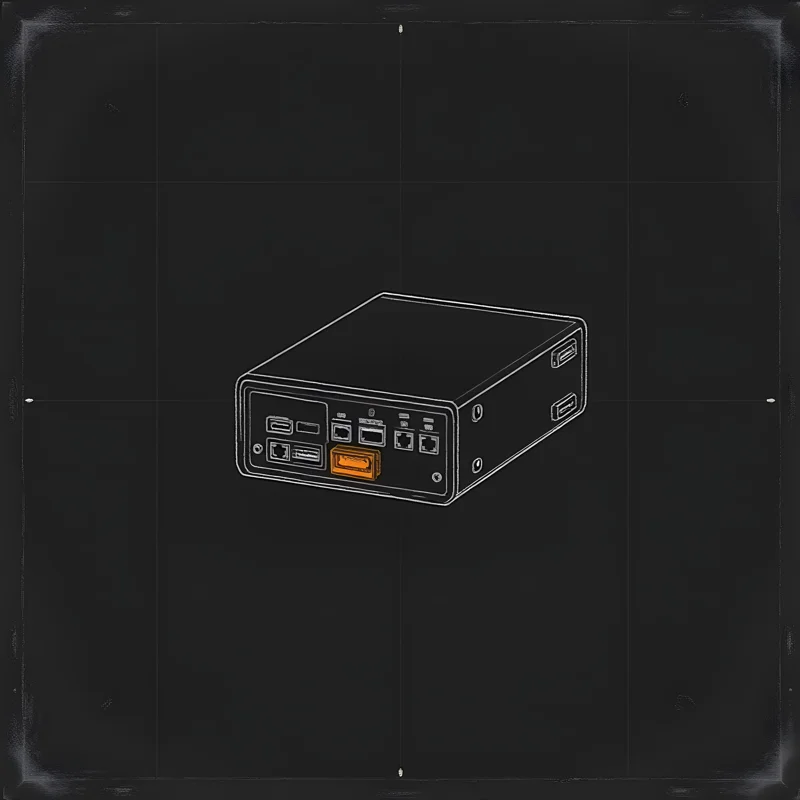
Bellows is the smallest and most boring node in the lab, and it’s the one that makes all the others possible. It’s a GL.iNet GL-RM1, a $200 palm-sized IP-KVM device: HDMI capture, USB keyboard emulation, a relay-controlled power switch, and its own tailnet membership. Its entire job is to sit plugged into the back of Furnace and give me a way to see the BIOS, watch a Linux boot sequence, or cold-reset the machine when I’m not physically next to it.
The reason it exists is a story I lived twice. The first time Furnace kernel-panicked at 2 AM and refused to reboot cleanly over IPMI (which Strix Halo doesn’t really have), I had to drive to where the lab is and physically power-cycle it. The second time, I bought Bellows. Now when something goes badly wrong on Furnace — a bad kernel upgrade, a frozen AMD driver, a GRUB misconfiguration that blocks SSH from coming back up — I can open a browser tab, see the Furnace console as if I were sitting in front of it, type into the BIOS, and power-cycle without leaving wherever I am. It has saved me two full lab trips since it was installed.
Bellows runs no services of its own beyond its stock firmware and the Tailscale client. It’s not part of the job queue, it doesn’t run models, it doesn’t host anything. What it does is enforce a reliability property: no matter what state the primary node gets into, there is always a way to reach into it from outside. A home lab without out-of-band access is a home lab that fails permanently the first time something goes wrong while you’re on a flight. The lesson was cheap the second time because the device was cheap; I’d buy it again in a heartbeat.